

You noticed something. Maybe it’s a crack that wasn’t there last month, a patch of ceiling that’s gone soft, or a door that used to close fine and now sticks. These are some of the most common signs your home needs civil repair, and you’re here because some part of you is asking: is this normal wear, or is this the kind of thing that needs civil repair services before it turns into a bigger problem?
Short answer: if you’re seeing more than one of the ten signs below, it’s worth getting a professional opinion now rather than later. Most of these signs are manageable and affordable to fix early. Left alone through a couple of monsoon seasons, several of them stop being cosmetic and start being structural, and the cost difference between those two categories is significant.
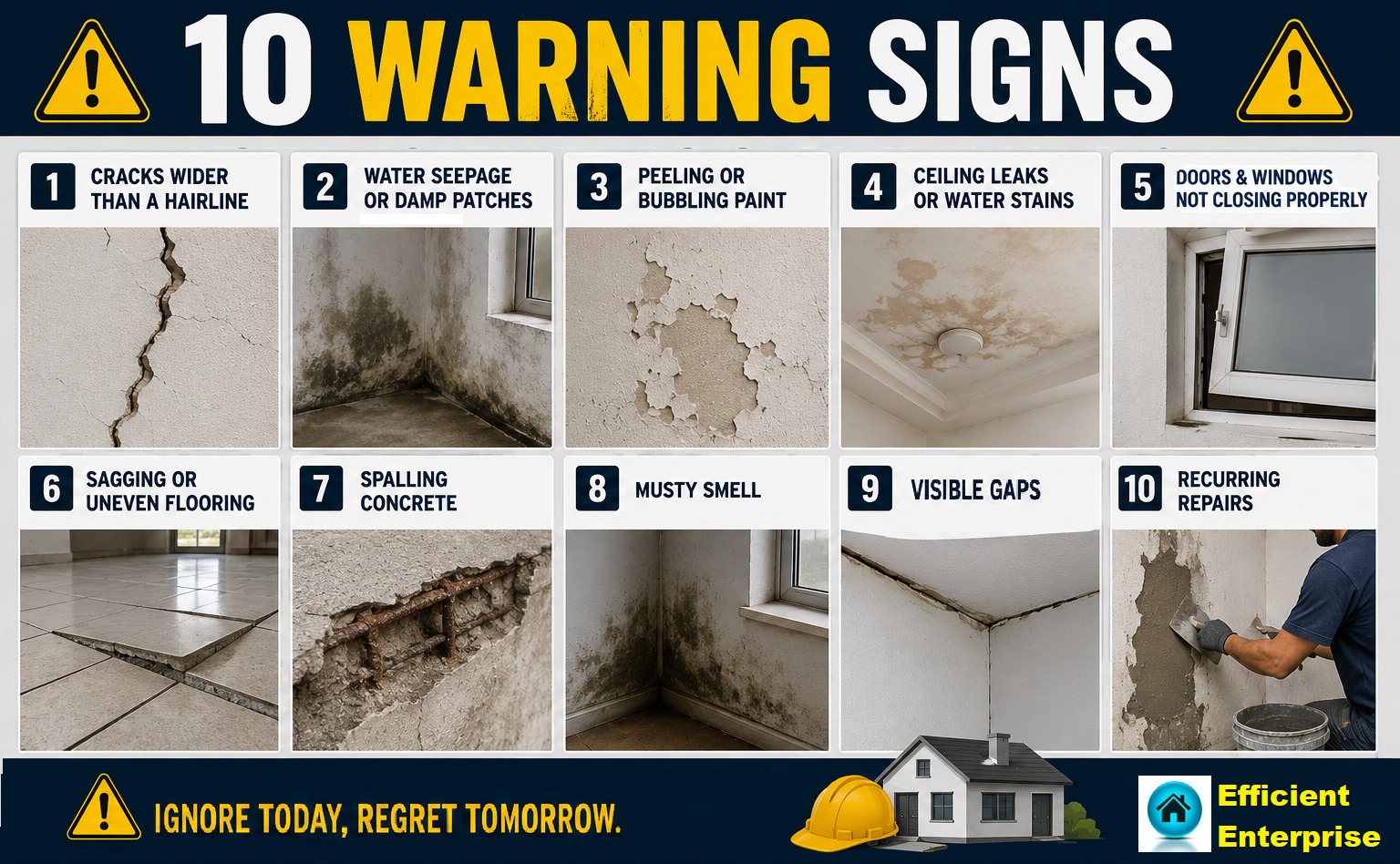
Here’s what to actually look for, what each sign usually means, and when you can handle it yourself versus when you need a civil contractor.
Why These Signs Tend to Show Up During Monsoon in Kolkata
Kolkata’s building stock takes a real beating every year between June and September. Heavy, sustained rainfall raises groundwater levels, saturates soil around foundations, and pushes moisture into walls that have even minor gaps in their waterproofing. Older constructions in areas like North Kolkata, along with buildings near the Hooghly floodplain, tend to show seepage and settlement issues earlier than newer gated communities with modern waterproofing membranes.
This is also why civil repair work often becomes visible in bursts. A crack that formed slowly over a dry season suddenly shows up clearly once monsoon moisture gets into it and the plaster around it starts to swell or flake. If you’re noticing several of these signs at once right now, monsoon conditions are very likely accelerating something that was already developing underneath the surface.
10 Signs Your Home Needs Civil Repair
1. Cracks Wider Than a Hairline
Not all cracks mean trouble. Thin, hairline cracks under roughly 1mm to 2mm, especially vertical ones running through plaster, are usually shrinkage cracks from the curing process or minor thermal movement, and they’re common in most buildings.
What should get your attention is a crack you can fit a coin edge or a matchstick into, generally anything approaching 3mm or wider. Indian building codes (IS 456:2000, the standard reference for concrete construction in India) treat crack width as a direct indicator of exposure risk, tightening the acceptable limit the more a structure is exposed to moisture. A wide crack isn’t just ugly; it’s a pathway for water to reach the reinforcement steel inside your walls or slabs.
Pay closer attention if the crack is:
- Diagonal or stair-stepping through brick joints (often linked to foundation settlement)
- Horizontal, running sideways across a wall (can indicate lateral pressure or bowing, generally the most serious pattern)
- Growing wider or longer over a few weeks, rather than staying the same size
2. Water Seepage or Damp Patches on Walls
A damp, discolored patch that appears after rain and doesn’t fully dry between showers is one of the most common triggers for civil repair services in Kolkata during monsoon. Seepage usually starts at a weak point, a hairline crack, a gap around a window frame, a compromised terrace waterproofing layer, and gets worse every rainy season until it’s addressed at the source.
The trap most homeowners fall into is repainting over a damp patch once it dries out in winter. The stain returns the following monsoon, often larger, because repainting treats the symptom, not the entry point.
3. Peeling or Bubbling Paint and Plaster
When paint bubbles, flakes, or plaster starts crumbling off in chunks, moisture has usually already worked its way behind the surface layer. This is frequently the first visible sign of seepage that’s been developing for a while inside the wall before it ever reached the surface you can see.
4. Ceiling Leaks or Water Stains Overhead
A brownish ring on your ceiling, especially on the top floor or under a terrace, points to a waterproofing failure above. Left unaddressed, this moisture can travel along the slab and start affecting adjacent walls, false ceiling structures, and even electrical wiring run through the ceiling void, which turns a repair job into a safety issue.
5. Doors or Windows That Suddenly Stick or Won’t Align
If a door or window frame that used to close smoothly now scrapes, sticks, or won’t sit flush, the wall or frame around it may have shifted slightly. This is sometimes due to humidity-related wood swelling (a carpentry fix), but when it’s paired with cracks nearby or happens across multiple doors in the same part of the house, it’s more often a sign of minor structural movement that a civil contractor should assess.
6. Sagging or Uneven Flooring
Floors that feel slightly sloped, or tiles that have started to lift, crack, or sound hollow when tapped, usually point to movement in the sub-base beneath the flooring. This can result from soil settlement, moisture intrusion under the slab, or aging bedding material. It’s rarely an emergency on day one, but it tends to worsen steadily rather than resolve on its own.
7. Spalling Concrete (Concrete Falling Away to Reveal Rusted Steel)
This is one of the more serious signs on this list. When concrete on a beam, column, or ceiling starts to crumble or fall away in patches, revealing rusted reinforcement bars beneath, it means moisture and air have penetrated the concrete and begun corroding the steel within. Rusting steel expands as it corrodes, which physically pushes the surrounding concrete apart from the inside, a process called spalling. This actively reduces the load-bearing capacity of that structural element and should be inspected by a structural or civil engineer without delay.
8. Musty Smell That Won’t Go Away
A persistent musty or damp smell, particularly in a room without any visible water damage yet, often means moisture is trapped somewhere you can’t see, inside a wall cavity, under flooring, or within an old waterproofing layer that’s failed internally. Smell frequently arrives before visible staining does, which makes it a useful early warning if you catch it.
9. Visible Gaps Between Walls and Ceiling, or Around Window Frames
A small gap opening up where the wall meets the ceiling, or around the frame of a window or door, usually indicates the wall and the structural frame around it are moving independently of each other, even slightly. On its own, a small gap might just need resealing. Combined with cracks or sticking doors elsewhere in the house, it’s a pattern worth having assessed together rather than patched individually.
10. Recurring Repairs in the Same Spot
If you’ve painted over the same patch, resealed the same window, or patched the same crack more than once in the last two to three years, that’s a sign in itself. Recurring damage in one location almost always means the underlying cause (a leak source, a structural crack, a drainage issue) was never actually fixed, only covered.
DIY vs Professional Civil Repair: What You Can (and Can’t) Safely Handle
Not everything on this list needs a contractor. Some of it is genuinely a weekend fix. The trouble is that homeowners often can’t tell which category a specific problem falls into until it’s already gotten worse, so here’s a practical breakdown.
| Situation | DIY-Appropriate | Needs a Professional |
| Hairline crack under 2mm, not growing | Yes, fill with acrylic crack filler and repaint | No |
| Crack wider than 3mm, or growing over weeks | No | Yes, needs assessment before any cosmetic fix |
| Small damp patch, first occurrence, dries fully in a day | Sometimes, if source is an obvious external gap you can reseal | Recommended if it returns each monsoon |
| Peeling paint with no bubbling or crumbling underneath | Yes, sand and repaint | No |
| Peeling soft plaster, crumbling, or hollow-sounding | No | Yes |
| Sticking door or window, isolated to one spot | Yes, a carpenter can usually plane/adjust it | Only if paired with nearby cracks |
| Ceiling water stains | No | Yes, source is almost always above the visible ceiling |
| Any spalling concrete or exposed, rusted steel | Never DIY | Yes, urgently |
| Musty smell without visible cause | No | Yes, needs a moisture source inspection |
| Sagging or uneven flooring | No | Yes |
The general rule worth remembering: if the fix is purely cosmetic (repainting a surface, resealing an obvious small gap) and the underlying material feels solid when you press on it, it’s usually safe to attempt yourself. If there’s any softness, crumbling, growing crack width, or the same issue has already come back once, that’s the point where a civil contractor should look at it before you spend money on a repair that won’t hold.
One thing DIY repair rarely fixes: the actual source of water entry. Painting over a damp wall or filling a crack from inside the room treats what you can see, not the compromised waterproofing layer, drainage slope, or structural gap letting water in from outside. That’s usually why the same spot keeps coming back, sign #10 on this list.
When Civil Repair Becomes a Bigger Renovation Conversation
Sometimes what starts as a single crack or a damp patch turns out, once a contractor actually opens up the wall, to be connected to a larger issue, aging plumbing lines behind a wall, a terrace waterproofing system that’s fully failed, or flooring that needs to come up entirely. In cases like that, it often makes more financial sense to fold the repair into a broader home renovation in Kolkata rather than patch the same spot a third time.
This is also a natural point where interior and civil work overlap. If a wall needs to be opened up for a structural fix, that’s often the right moment also to update the false ceiling, repaint the full room instead of just the patch, or reconsider the layout of that space while it’s already under work. Efficient Enterprise handles both sides of this under one roof, civil repair and structural fixes alongside home interior design and renovation, so a repair project doesn’t turn into three separate contractors who don’t coordinate with each other.
What Happens If You Ignore These Signs
None of these ten signs cause immediate danger the day they appear. That’s exactly what makes them easy to postpone. But civil repair costs generally follow a predictable pattern: a problem caught early is a localized, inexpensive fix. The same problem caught two monsoons later usually means replacing more material, repairing a wider area, and sometimes addressing secondary damage it caused along the way, such as damaged electrical wiring from a ceiling leak, or flooring that needs replacing because water sat under it for months.
Spalling concrete and active structural cracks are the two signs on this list where waiting has the most serious downside, since both involve the load-bearing capacity of the structure itself, not just its appearance.
Frequently Asked Questions
Is every wall crack a structural problem?
No. Most cracks are non-structural, caused by plaster shrinkage or minor thermal movement, and are cosmetic. The signs to watch for are width (generally above 3mm), a diagonal or stair-step pattern, or a crack that’s actively growing rather than staying the same size.
How do I find a reliable civil contractor near me in Kolkata?
Look for a contractor or firm with verifiable past project photos, a physical office address rather than only a phone listing, and a clear process for inspection before quoting. Many general home repair service providers handle cosmetic fixes, but for anything involving cracks, spalling, or seepage, ask specifically whether they assess the root cause before starting work, not just the visible symptom.
Does home insurance cover civil repair or monsoon damage in India?
It depends entirely on your specific policy. Standard home insurance in India typically covers sudden and accidental damage (like a burst pipe) more readily than gradual damage from long-term seepage, which many insurers classify as a maintenance issue rather than a covered event. Check your policy wording directly, or ask your insurer before assuming coverage.
Can I just repaint over a damp patch instead of fixing the source?
You can, but it’s a temporary fix. Repainting without addressing the source (a crack, a failed waterproofing layer, a gap around a frame) almost always means the stain returns the next monsoon, often larger than before.
What’s the difference between civil repair and renovation?
Civil repair addresses structural or water-damage issues, cracks, seepage, spalling, and foundation-related problems. Renovation is broader and includes design, layout changes, and finishing work. The two often overlap on the same project, especially when a wall needs to be opened up for a repair and it makes sense to update the finish or layout at the same time.
Is your home showing any of these signs?
Don’t wait for minor cracks to become major structural disasters. Contact Efficient Enterprise today for an expert structural inspection and premium Civil Repair Service in Kolkata.