
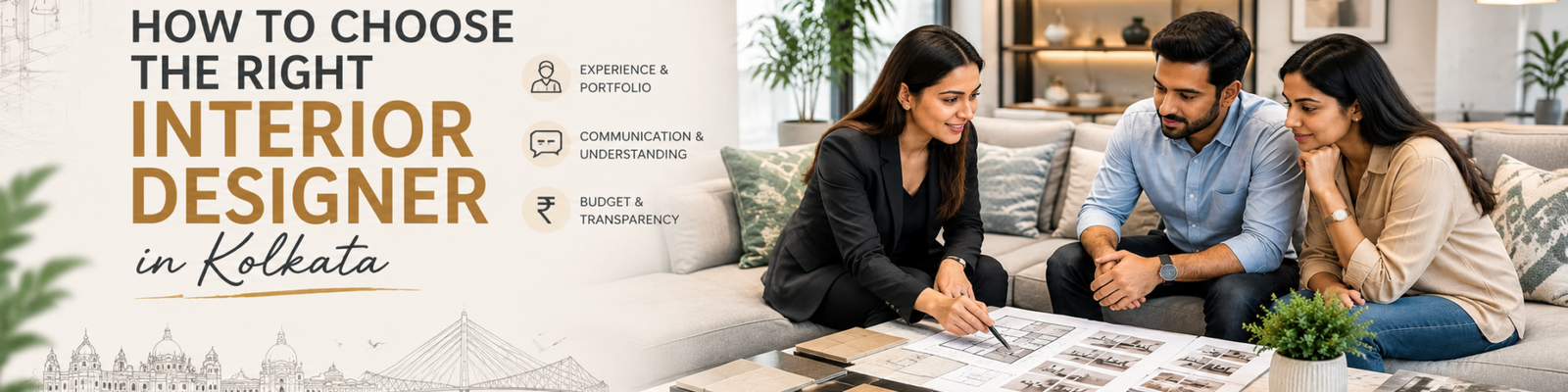
Most people don’t research their interior designer the way they’d research a doctor or a lawyer. They see a nice Instagram feed, get a warm first meeting, and sign. Then three months into the project, the same questions show up: who’s actually on site today, why did the quote change twice, and why hasn’t anyone called back in a week.
Choosing the right interior designer in Kolkata isn’t really about finding someone with good taste. Most firms clear that bar easily. The harder part is finding someone whose process, pricing, and accountability actually hold up once real money and a real deadline are involved. The ten questions below are designed to surface exactly that, before you’re locked into a contract, not after.
Why This Decision Is Harder to Get Right in Kolkata Specifically
Kolkata’s interior design market is large, referral-driven, and largely unregulated. Unlike architects, who need to be registered with the Council of Architecture to legally practice, there’s no equivalent licensing requirement for interior designers in India. Anyone can call themselves an interior designer, put together a portfolio, and start taking projects. That’s not automatically a red flag, some of the best people in this field are self-taught and highly skilled, but it does mean the burden of vetting falls entirely on you, the client, rather than on a regulatory body doing it for you.
This is also a market where a large share of business comes through word of mouth rather than online research, so a lot of reputational information (missed deadlines, cost overruns, poor communication) never makes it online where you’d find it before hiring. Asking direct questions upfront is, practically speaking, your main tool for filling that gap.
Before You Even Meet Them: A Quick Credential Check
You don’t need a design degree to evaluate a designer, but a few quick checks take five minutes and rule out the worst outcomes early.
- Look for a portfolio of completed, not just rendered, projects. 3D renders show intent. Photos of a finished, lived-in space show execution.
- Check for professional body association, most commonly the Institute of Indian Interior Designers (IIID). <cite index=”4-1″>Membership in a body like the IIID isn’t legally required, but it does signal a baseline commitment to professional standards and ethics that some independent decorators don’t have.</cite>
- Confirm they’ve worked on projects similar in scale to yours. A designer who’s done a dozen large villas may not be the right fit for a tight 2BHK budget, and vice versa.
None of this replaces the ten questions below, but it filters out obviously unqualified options before you spend an afternoon in meetings.
The 10 Questions to Ask Before Hiring an Interior Designer in Kolkata
1. Can I see your portfolio of similar homes or offices in Kolkata specifically?
A national portfolio full of Mumbai penthouses tells you less than three or four completed projects in Kolkata, ideally ones close to your own home size and budget. If you’re hiring a home interior designer in Kolkata for a 2BHK, ask specifically for 2BHK work, not just their best, biggest project. Style is easy to fake with good photography. Consistency across several real projects is harder to fake.
2. Are you a turnkey provider or a modular-only service?
This single question saves a lot of confusion later. A modular-only provider handles kitchens and wardrobes but won’t touch your painting, false ceiling, or civil work. A turnkey provider manages the entire project under one contract. If you’re not sure which one you actually need, our guide on turnkey vs modular interior design breaks down the practical difference in more depth. Either model can be the right choice, the problem is only when you think you’re getting one and end up with the other.
3. What exactly is included in your quoted price?
Ask for a line-item breakdown, not just a lump sum. Specifically ask whether the quote includes design fees, material costs, labour, and any furniture or décor, or whether some of these are billed separately as the project progresses. This is also where trade discounts come up. Many designers get preferential pricing from suppliers and pass some portion of that saving to the client while keeping a share as part of their fee.
4. Who’s actually going to be on site managing execution?
The person who impressed you in the sales meeting is not always the person managing your project day to day. Ask directly whether execution is handled by an in-house team or subcontracted out, and who your actual point of contact will be once work begins. This matters more for larger projects, like a full 3BHK interior design job or an office fit-out, where multiple trades are working in parallel and someone needs to be accountable for coordinating them.
5. What’s a realistic timeline for a project like mine, and what could delay it?
Every designer will give you a number. The better question is what could push that number out, material delivery delays, approval bottlenecks on your end, or dependencies on other contractors. A designer who can walk you through realistic risk factors, rather than just quoting an optimistic best-case timeline, is usually more experienced and more honest about how projects actually go.
6. How often will I get updates, and in what format?
Some designers send weekly photo updates over WhatsApp. Others expect you to visit the site yourself. Neither approach is wrong, but you should know which one you’re signing up for, especially if you have a full-time job and can’t be available for daily site visits. If a designer is vague about this, it’s usually because they don’t have a defined communication process, which tends to become a bigger frustration than people expect once the project is underway.
7. Can I speak to a recent client, ideally one whose project is already finished?
A finished project reference tells you something a portfolio photo can’t: how the relationship held up under pressure, whether the final handover matched what was promised, and whether issues after completion were actually addressed. Most reputable designers can provide at least one such reference without hesitation. Hesitation here is worth noting.
8. What happens if I want to make changes mid-project?
Design briefs shift. You’ll see something on-site that looks different than you imagined, or your budget will need adjusting. Ask how change requests are handled: is there a formal process, does it affect the timeline, and how is the added cost communicated before the change is made rather than after.
9. Is there a warranty or support period after handover?
A project isn’t really finished the day the furniture is placed. Ask what happens if a cabinet hinge fails in month two, or if a seam in the flooring lifts. Reputable firms typically offer some defined workmanship warranty period after handover. If a designer can’t answer this clearly, that’s worth factoring into your decision.
10. Do you handle residential and office projects, or do you specialize in one?
If you’re an office owner researching office interior designer options in Kolkata, this matters more than it might seem. Commercial fit-outs involve different considerations than homes, electrical load planning, workstation layouts, sometimes compliance requirements, and a designer whose primary experience is residential may not be the strongest fit for a commercial brief, even if their home projects look excellent.
Quick Reference: What to Ask Based on Your Project Type
| If you’re hiring for… | Prioritize asking about… |
| A 2BHK or 3BHK home | Kolkata-specific portfolio examples, budget transparency, and timeline realism. |
| A full home renovation | Turnkey vs modular scope, on-site execution ownership, and change-request process. |
| An office or commercial space | Realistic timeline against your opening/lease date communication cadence and Sector-specific experience. |
Red Flags Worth Taking Seriously
Not every hesitant answer is disqualifying, but a pattern of these is worth pausing on:
- Refuses to provide any client reference, even a past one
- Quote has no material or labour breakdown, just a single total figure
- Can’t clearly explain who manages on-site execution
- Pressures you to sign within days, before you’ve had time to compare options
- No mention of any warranty or post-handover support when asked directly
Frequently Asked Questions
Is it necessary to hire an IIID-registered interior designer in Kolkata?
No, it’s not a legal requirement. IIID membership is a positive signal of professional standards, but plenty of skilled designers and firms in Kolkata operate without it. It should be one data point among several, not a hard filter on its own.
How many designers should I actually meet before deciding?
Three is a reasonable number for most residential projects. It’s enough to compare pricing structure, communication style, and portfolio fit without dragging the decision out for weeks.
Should I choose a bigger firm or an independent designer?
It depends on project complexity. Larger firms, like Efficient Enterprise, generally offer more structured execution, dedicated project management, and defined warranty terms, which tends to matter more on full home or office turnkey projects. Independent designers can offer more personal attention on smaller, more design-focused jobs. Neither is universally better, the right fit depends on your project’s scope.
What’s the biggest mistake homeowners make when choosing a designer?
Choosing based on the initial sales meeting alone, without asking about execution, timeline risk, or post-handover support. The sales conversation is usually the most polished part of the entire process. The questions above are designed to look past it.
Efficient Enterprise has been designing and executing home and office interiors across Kolkata since 2000, with in-house teams handling design through to final execution rather than subcontracting out the work. If you’re comparing designers for a 2BHK, 3BHK, or office project, get in touch and ask us the same ten questions above. We’d rather you ask than assume.