
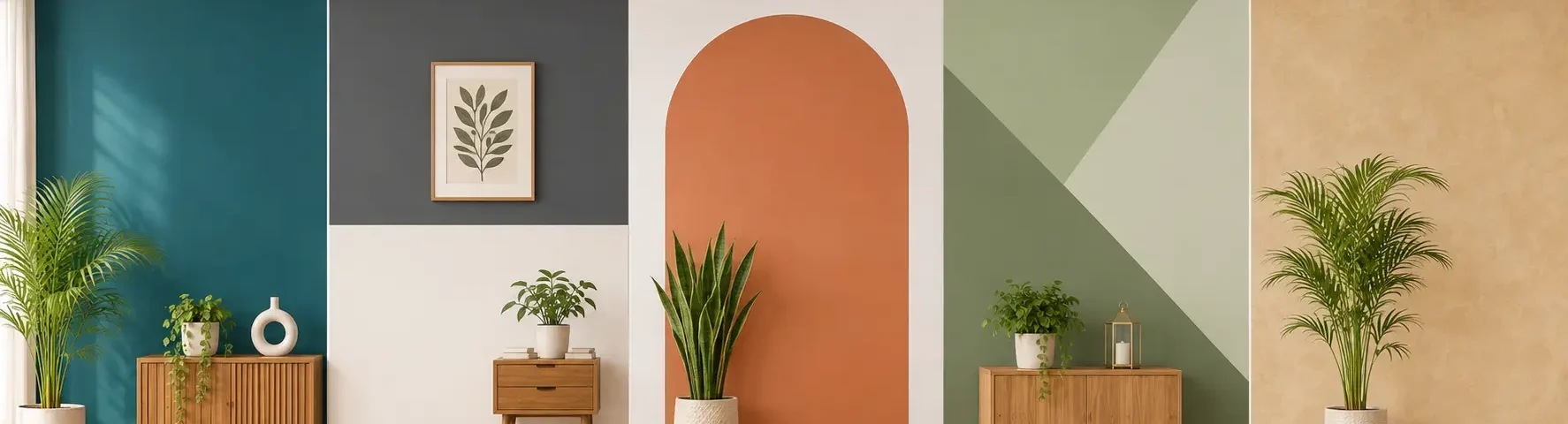
The best wall painting designs for a hall or drawing room are accent walls, two-tone splits, geometric patterns, textured paints, ombre gradients and tonal neutral schemes. Pick one feature wall, keep the rest calm, and match the paint finish to how the room is used. In Kolkata, also check the wall for dampness first, because even the best wall painting design for a hall will peel if moisture is hiding behind it.
Below you will find 15 modern designs, grouped so they are quick to scan, plus small-hall tricks, 8 two-colour combinations, a paint finish guide, and what to know before painting in Kolkata’s humidity.
Hall or drawing room? In many Indian homes, the two words mean the same room: the main space where family relaxes and guests sit. Every idea here works for either.
Quick Answers
- Easiest design to start with: One accent wall, either a few shades deeper than the rest of the room or in a contrasting colour.
- Best for a small hall: Light warm neutrals with a single soft accent wall.
- Best finish for most halls: Matte or soft sheen on walls, satin where hands touch the wall often.
- Most important step in Kolkata: Fix the moisture source and use a damp-resistant primer before any paint goes on.
- Smartest colour test: Paint a 2 ft x 2 ft patch (two coats, over a primed or white base) and check it in morning, afternoon and night light.
How to Choose a Wall Colour Design for Your Hall
A good home wall paint design starts with the room, not the shade card. A colour is never judged alone. It is judged by the light in your room, the furniture beside it and the floor beneath it, which is why a shade that looks perfect on a shade card can look different on your wall.
Before you pick a wall colour design for your hall, ask four things:
- How big is the room? Small halls and low ceilings need lighter colours and simpler designs. Large halls can carry bold colours and texture. If the hall opens into a dining area, plan both as one space.
- Where does the light come from? North-facing rooms and rooms with weak daylight usually feel better in warm tones. Bright south or west-facing rooms can handle cooler shades. Also think about your evening bulbs: warm white (2700K to 3000K) enriches creams and beiges, while cool white (6000K to 6500K) can make warm colours look washed out.
- What is already there? Your sofa, curtains, flooring and wood tones should guide the choice. Cool white marble or grey tiles pair cleanly with crisp off-whites, sage or navy, while warm beige tiles and teak furniture suit creams and greige. Walls are the backdrop, not the main actor.
- Who lives here? Homes with children, pets or frequent guests need washable paint and less delicate textures. Deep textures and porous finishes such as limewash also trap dust and are harder to wipe.
15 Modern Wall Painting Designs for Hall & Drawing Room
The designs are grouped so you can see them together. Each group is shown as one combined image, followed by short notes on every idea.
Simple Wall Painting Designs for Home (Easy Starting Points)
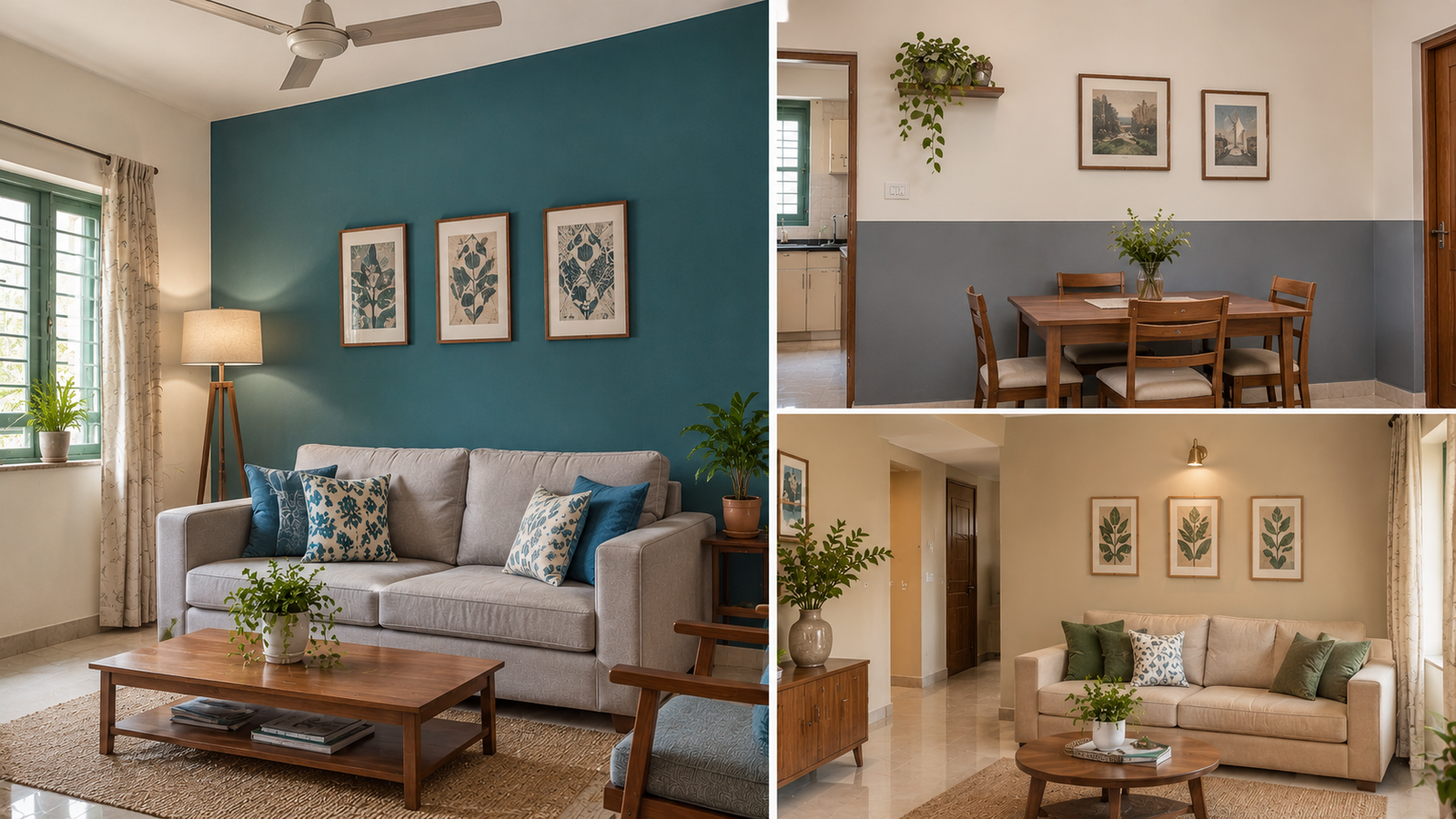
1. Single Accent Wall
Paint the wall behind the sofa or TV unit in a deeper or brighter shade than the rest of the room. Deep teal, terracotta or forest green against warm white is a reliable pairing. It is the easiest way to make a hall look planned, and it needs no special skill, which keeps the cost low.
2. Two-Tone Horizontal Split
Divide the wall at roughly one-third of its height (about 3 to 3.5 ft in a typical flat), with a darker shade below and a lighter one above. A one-third split keeps the wall feeling tall, while an exact half split can make a low ceiling feel shorter. The lower section hides scuffs well, so it suits busy family rooms. Use satin on the lower half and matte on top.
3. Tonal Monochrome
Use several shades of one colour family across walls, trim and feature areas, with matte on the walls and semi-gloss on the trims. Greige, warm sand and soft sage work well. It creates a calm, continuous look that is especially good for small halls, and it is one of the most budget-friendly wall painting ideas at home.
Pattern-Led Wall Painting Designs
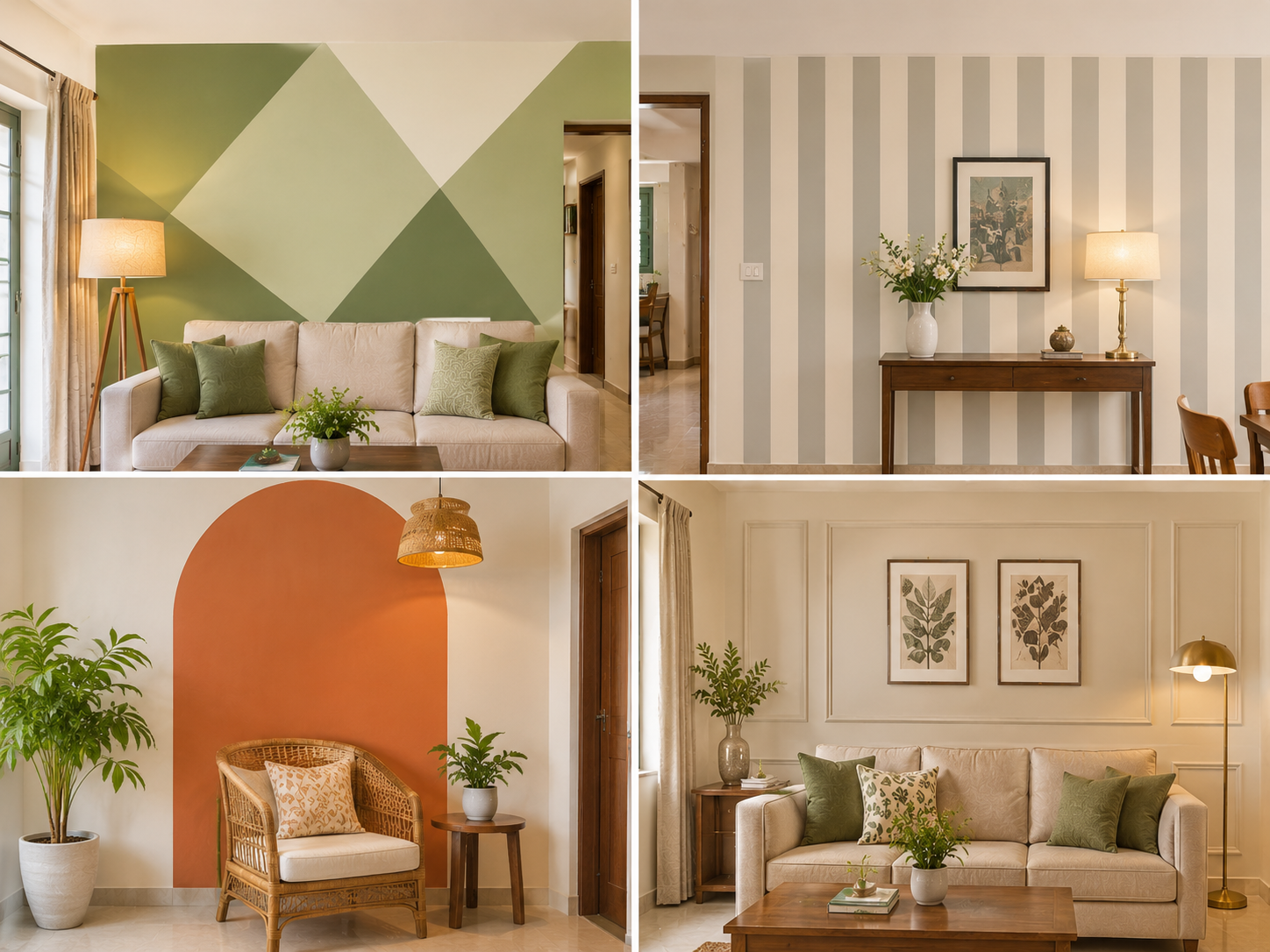
4. Geometric Patterns with Painter’s Tape
Triangles, chevrons or colour blocks made with painter’s tape look sharp and contemporary. Stay within two or three shades of the same family for a refined result. Use low-tack painter’s tape on a fully dry base coat (allow longer in humid weather) and peel it off slowly at an angle before the top coat fully hardens. It costs a little more than a plain wall because it needs careful, precise labour.
5. Vertical Stripes
Stripes can draw the eye upward and make a low ceiling feel taller, which helps in many apartment halls. Stripes roughly 4 to 8 inches wide look balanced, while very narrow ones look busy and add taping work. Cream and light grey, or ivory and sage, keep it subtle. Using matte and satin in the same colour gives a quiet shine difference without a loud contrast.
6. Painted Arch
An arch painted behind the sofa, console or a statement chair gives you a focal point without any construction. Terracotta or mustard on a white wall is a popular choice. Let it extend a little beyond the furniture so it frames it, and keep the top well below the ceiling or false-ceiling line. It is cheap, quick and easy to repaint later.
7. Painted Panel Frames
Thin painted rectangles, or light moulding lines, create a classic panelled effect without full wall panelling. Painted lines need only tape and paint, while physical mouldings (POP, PU or MDF strips) need carpentry and cost more. Keep the frames tone-on-tone, slightly lighter or darker than the wall. It suits neo-classical or transitional drawing rooms.
Texture and Finish-Led Designs
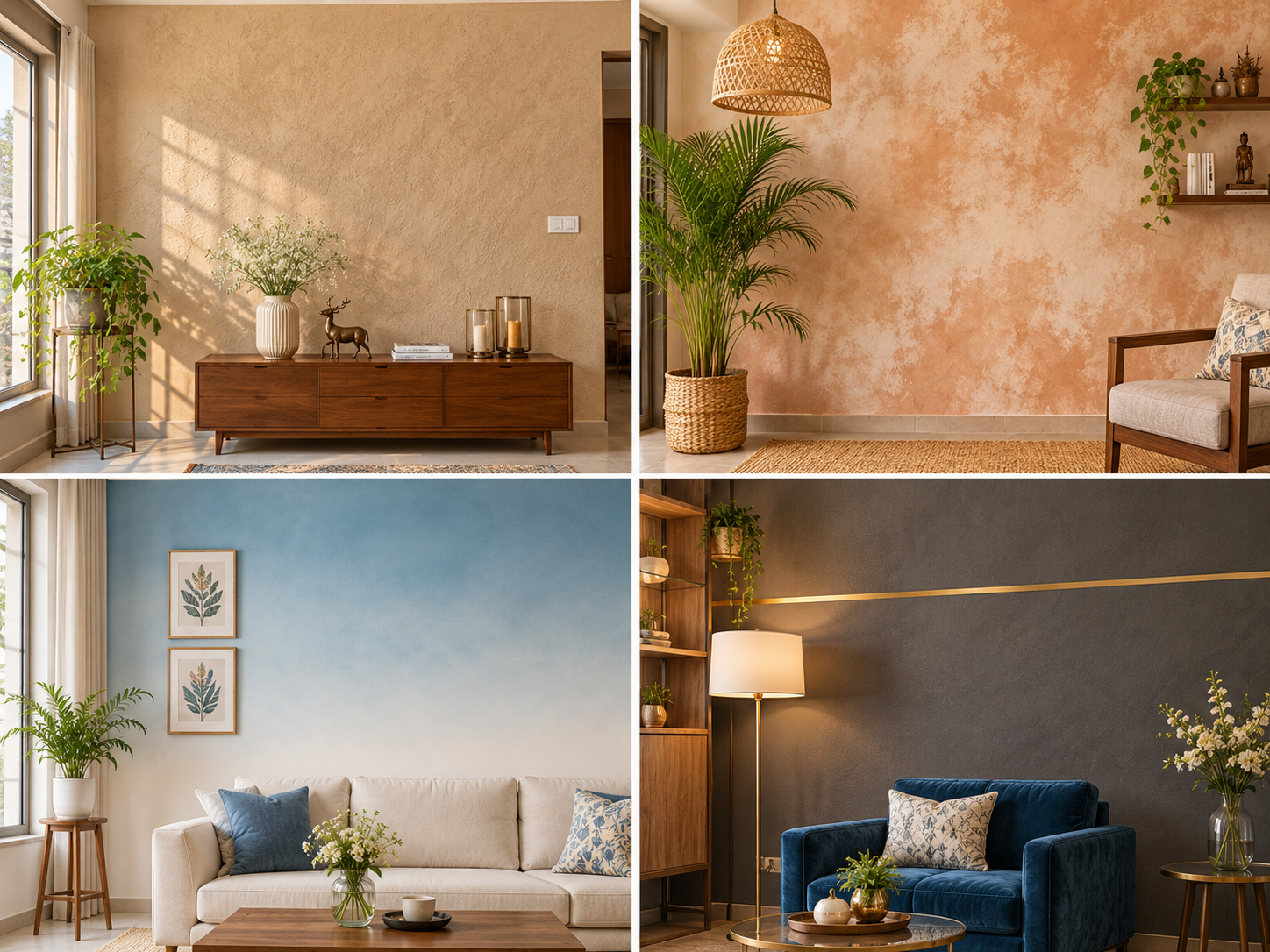
8. Textured Paint Wall
Texture paints create sand, stucco, wave or soft plaster effects. They add depth and hide small wall imperfections, so they work well on a feature wall that catches side light. Deep textures trap dust and are hard to patch invisibly later, so keep them to one feature wall and away from damp-prone corners. Expect a higher cost than plain paint because of the material and the skill needed.
9. Limewash-Style Wall
This finish looks like aged plaster, with soft clouds of colour. It adds an earthy, handmade feel in warm white, clay or pale green. Traditional mineral limewash is breathable but chalky unless sealed, while most limewash-style finishes in apartments use washable special-effect emulsions. Ask your painter which one they plan to use, because it decides how the wall handles humidity and cleaning.
10. Ombre or Gradient Wall
The wall fades from one shade to another, such as pale blue to white or peach to cream. It creates a soft, artistic mood, but water-based paint dries fast in warm rooms, so blending needs a skilled painter. Budget accordingly.
11. Metallic or Shimmer Accent
A stripe, border or small panel in champagne gold or bronze catches light and adds a touch of luxury to a formal drawing room. Use it sparingly against a deep neutral wall, and avoid covering a whole wall. Metallic paint shows every roller mark, so the wall must be smooth and well puttied first.
Statement and Focal-Point Designs
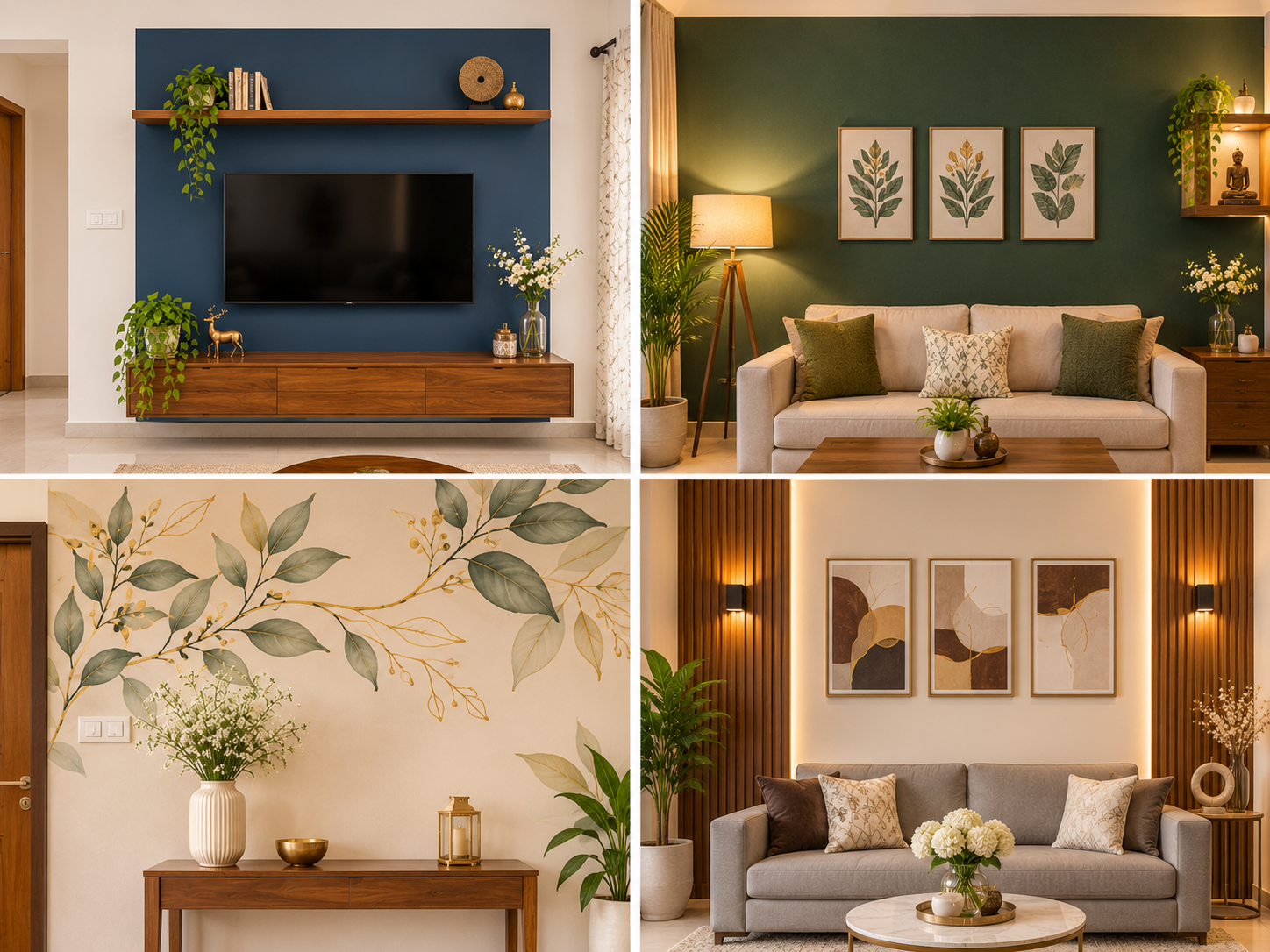
12. Colour-Blocked TV Wall
A rectangle or large block of colour around the TV unit frames the screen and makes the wall look intentional. Extend the block a few inches beyond the TV unit on each side. Navy, charcoal or olive work well, and dark matte colours also reduce screen glare.
13. Dark, Moody Feature Wall
Deep navy, bottle green or soft black gives a hall depth and drama when paired with warm lighting and light furniture. Always choose matte for dark shades, because gloss shows every flaw. Dark colours may need an extra coat, and a grey-tinted primer underneath helps them cover evenly.
14. Botanical or Nature Mural
Hand-painted or stencilled leaves and branches bring personality to the wall behind a console or seating area. Muted greens and golds on a neutral base keep it elegant. The price depends on the artist and level of detail.
15. Paint with Wooden Slats or Panelling
Combining a painted wall with fluted wood or mouldings softens the wood and adds warmth. Warm white or soft grey with walnut or oak tones is a safe pairing. In humid Kolkata, choose moisture-resistant materials such as treated boards or WPC panels over plain MDF or untreated wood, and prime and paint the wall behind the slats before installation. This is the most premium option here because of the carpentry involved.
Quick Comparison of All 15 Designs
| No. | Design | Relative Cost | Skill Needed | Best Finish |
|---|---|---|---|---|
| 1 | Single accent wall | Low | Basic | Matte or soft sheen |
| 2 | Two-tone split | Low to mid | Basic | Satin below, matte above |
| 3 | Tonal monochrome | Low | Basic | Matte walls, semi-gloss trims |
| 4 | Geometric painter’s tape pattern | Mid | Experienced painter | Matte |
| 5 | Vertical stripes | Mid | Experienced painter | Matte and satin |
| 6 | Painted arch | Low | Basic | Matte |
| 7 | Painted panel frames | Mid | Experienced painter | Matte |
| 8 | Textured paint | Mid to high | Specialist | Matte or low-sheen topcoat |
| 9 | Limewash style | Mid to high | Specialist | Matte |
| 10 | Ombre gradient | Mid to high | Experienced painter | Matte |
| 11 | Metallic accent | Mid to high | Experienced painter | Metallic glaze |
| 12 | Colour-blocked TV wall | Low | Basic | Matte |
| 13 | Dark moody wall | Low to mid | Basic | Matte |
| 14 | Botanical mural | Mid to high | Specialist | Matte |
| 15 | Paint with wood panels | High | Carpenter and painter | Matte or soft sheen |
Best Wall Painting Designs for a Small Hall (To Make It Look Bigger)
For a small hall, use light warm colours, keep the design simple and deepen only one wall. Light shades reflect more light and make a room feel open, while heavy patterns crowd it.
The designs that help most are a soft accent wall (only one or two tones deeper than the main colour), vertical stripes, which can help add height, tonal monochrome to remove visual breaks, and a white or very light ceiling to lift the room. A gentle light-to-slightly-deeper gradient can also add depth without weight.
Avoid dark colours on all four walls, heavy texture on every surface, strong contrast between wall and ceiling, and busy prints near windows.
In many Kolkata flats, the hall also holds the dining table or leads straight into a passage. In that case, use one base colour throughout and let a single feature wall carry the design.
Two-Colour Combinations for Drawing Room Walls
A good two-colour wall paint design for a drawing room uses one dominant colour on about 70% of the wall area and one supporting colour on about 30%. The supporting colour usually goes on the accent wall or the lower half. Across the whole room, this fits the classic 60-30-10 guide: about 60% main colour, 30% secondary colour (accent wall, sofa, curtains) and 10% small accents such as cushions, rugs and art.
| Combination | Main Colour | Accent Colour | Mood | Pairs Well With |
|---|---|---|---|---|
| Warm white + sage green | Warm white | Sage green | Fresh, calm | Light wood, cane, cotton |
| Beige + terracotta | Soft beige | Terracotta | Earthy, warm | Brass, jute, teak |
| Light grey + mustard | Light grey | Mustard | Modern, cheerful | Charcoal sofa, black metal |
| Off-white + navy | Off-white | Navy | Classic, elegant | Tan leather, brass lights |
| Cream + dusty rose | Cream | Dusty rose | Soft, welcoming | Velvet, gold accents |
| White + light blue | White | Light blue | Airy, relaxed | Natural wood, glass |
| Ivory + teal | Ivory | Deep teal | Rich, stylish | Walnut, marble, bold art |
| Greige + charcoal | Greige | Charcoal | Contemporary | Metal, glass, textured rugs |
Put the lighter colour on the window wall and the walls that bounce light around the room, and the deeper colour on a solid wall such as the one behind the sofa or TV. A dark window wall creates harsh contrast and glare against daylight. Keep ceiling, trim and doors neutral. Then check the colours at night, because warm white bulbs (2700K to 3000K) push colours towards yellow and cool white (6000K to 6500K) towards blue.
How to Choose the Right Paint Finish for Your Hall (Matte vs Satin vs Sheen)
Choose matte for most hall walls, a soft sheen or satin where walls are touched often, and semi-gloss enamel for doors and trims. Matte hides uneven walls and gives colour depth, while higher-sheen paints are easier to wipe but show every bump and crack.
| Finish | Best Used On | Watch Out For |
|---|---|---|
| Matte | Main walls, ceilings, dark feature walls | Basic matte marks easily, so choose a washable one |
| Soft sheen / Eggshell | Living and drawing room walls | Shows minor wall flaws slightly more |
| Satin | Passages, children’s areas, lower half of two-tone walls | Highlights uneven putty |
| Semi-gloss enamel | Doors, trims, window frames | Highlights every bump and crack, so not for large walls |
Brands name these gloss levels differently (soft sheen, eggshell, silk, luxury emulsion), so check the gloss level on the can. Washability depends on paint quality as much as gloss, so a premium washable matte can be easier to clean than a basic satin.
Painting Your House in Kolkata: Humidity and Dampness
Kolkata’s humidity and monsoon can cause damp patches, peeling and fungus on interior walls, especially in older buildings and walls that face outside. Any house painting design needs a dry, sound wall, or the paint will fail within months.
Check for bubbling paint, white powdery salt deposits, black or green spots, and cracks near windows and corners. Then follow this order: fix the moisture source, scrape off loose paint, dry-brush off white salt deposits (do not soak the wall), treat black or green spots with an anti-fungal wash and let the wall dry, seal cracks, apply a damp-resistant or alkali-resistant primer, level with putty, apply a second primer coat, and finish with a quality emulsion. Products differ by brand, so ask your painter to follow the paint manufacturer’s recommended system for damp walls. Let each coat dry fully, because drying takes longer in monsoon, so many homeowners plan major repainting after the rains.
Many Kolkata families repaint before Durga Puja or Diwali. Book painters early, because slots fill up fast in that season.
Common Mistakes to Avoid
- Choosing from a screen or small swatch. Test a 2 ft x 2 ft patch on the wall instead.
- Painting over damp or flaking walls. Fix the moisture and the loose paint first.
- Using too many colours. Two or three shades are enough for a hall.
- Ignoring furniture and flooring. The wall colour has to work with them.
- Skipping the primer. It improves adhesion and colour evenness.
- Using high-sheen paint on uneven walls. It shows every flaw.
- Forgetting the ceiling and trims. They change how the wall colour looks.
Frequently Asked Questions
What is the best wall painting design for a hall?
An accent wall is the best starting point for most halls. Paint the wall behind the sofa or TV in a deeper shade and keep the other walls light. It adds depth without crowding the room and works in both small and large halls.
Which colour is best for a small hall?
Warm white, soft beige, light grey and pale green are the safest choices. They reflect light and make the room feel open. If you want colour, use a muted shade on just one wall.
Which house wall colour suits Kolkata homes?
Light, warm neutrals such as ivory, cream, soft greige and pale green suit most Kolkata homes. One continuous base colour works well in flats where the hall and dining area share a space, and light shades keep rooms bright on overcast monsoon days. On outside-facing walls, ask for a damp-resistant primer and an anti-fungal, washable emulsion.
Can I use two colours on drawing room walls?
Yes. Use one main colour on about 70% of the wall area and a second colour on one accent wall or the lower half. Combinations such as warm white with sage green, or off-white with navy, look balanced and match most furniture.
Which paint finish is best for a hall: matte, satin or sheen?
Matte suits most hall walls because it looks smooth and hides flaws. A soft sheen or satin works better where walls are touched or cleaned often. Semi-gloss enamel is best for doors and trims. A mix of finishes gives a polished result.
Are there simple home wall painting designs I can try myself?
Yes. An accent wall, a two-tone split or a painted arch are easy to plan with painter’s tape and a good roller. Geometric patterns are also doable with patience. For textures, murals or gradients, a professional gives a cleaner result.
How often should I repaint my hall in Kolkata?
Most homes repaint every 3 to 5 years, depending on paint quality, wall condition and wear. In Kolkata, walls with monsoon seepage can show bubbling, white salt deposits or fungus much sooner. In that case, treat the dampness and use a damp-resistant primer first, because repainting alone only hides the problem for a short time.
Do I need a designer to choose a home wall design?
Not always. A simple accent wall is easy to plan yourself. A designer helps when you want walls to match furniture, lighting, false ceiling and flooring, or when you are planning a full home interior.
Not Sure Which Wall Design Fits Your Hall?
Choosing a wall design is easier when you can see it in your actual room. At Interiors Kolkata, our designers help homeowners choose wall colours, finishes and feature walls that suit their space, light and budget.
Share your room size and a few photos, and we will suggest options that fit your home.